Wednesday, November 7, 2012

Conditions Pictures from RMNP

Winter is making it's way! Here are a few shots from the past week that CMS Guides Mike Lewis and Joey Thompson took from the field.


All Mixed Up is IN and in great condition from bottom to top. Mike and Joey got after it yesterday November 6, 2012. Check out these pics from the route:


All Mixed Up on the hike in, 11/6/2012
Mike Lewis on the second pitch of All Mixed Up - 11/6/2012


Mike Lewis mid-way on All Mixed Up - 11/6/2012
 
Topping out on All Mixed Up - November 6, 2012


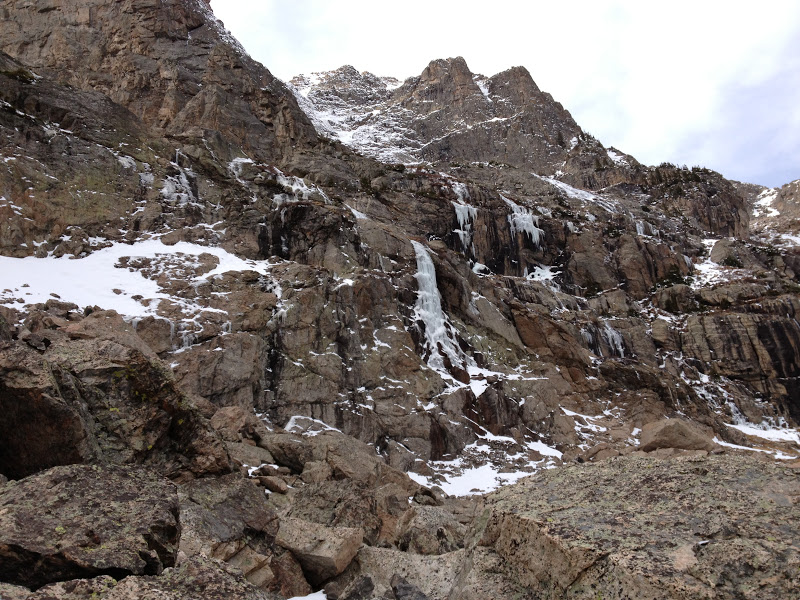
Grace Falls in Early Conditions - Photo by Mike Lewis, CMS Guide, Nov 1, 2012
Grace Falls Nov 1, 2012
 
Notchtop November 1, 2012
 
 
Mike reported really good climbing (albeit a bit wet) at Grace Falls with an easy approach. The other ice in the area hadn't shown up yet. The upper pitches on the NE Face of Notchtop looked great but did not have anything in below them.


Ice at Columbine Falls - November 3, 2012


Ice at Columbine Falls: The far right flow was in excellent condition. One pitch of 30-40 feet of steep and 50-60 feet of low angle ice. WI4-WI2 with WI3 variations. Mike saw a flow directly above Peacock Pool that looked great from far away ~ WI4.


CMS Senior Guide Joey Thompson and clients Kim and Darren Walker made the trip to Rocky Mountain National Park on November 3 in search of snow and ice to run the Intro to Mountaineering course. Conditions were lean but they did find some snow and ice to practice their skills on. Here is a shot from below Hallett's with the Dragon Area in the background.

 
The weather report is showing potential for snow in the Park this weekend. We are psyched for more ice and snow and a great winter season!
 
 
Cheers,
 
Colorado Mountain School
11/7/2012

Tuesday, October 23, 2012

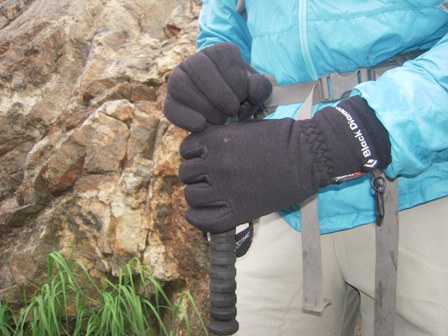
Guide Gear Review: Black Diamond LightWeight Glove


The Black Diamond LightWeight Gloves are a consistent item in my pack no matter what time of year. The LightWeight Glove does not receive the time in the spotlight it deserves. This is partly because in the winter they are often hidden under my outer gloves like the Black Diamond Legends or Guide Gloves (each awesome in their own right). But no matter the season, these LightWeight gloves keep my hands warm and working.
BD LightWeight Glove keeping me warm on the hike in to climb.

In summer I wear the LightWeight Gloves in the morning while hiking to alpine climbs. They are perfect wicking gloves for highly aerobic activities and they dry out quickly. In the fall and winter these gloves become my liner gloves under alpine ice climbing or ski gloves. In the spring the LightWeight gloves work great by themselves when I am skinning uphill to ski the corn. The LightWeight Gloves are soft and comfortable next to my skin. I pretty much don’t go outside without them!
These gloves rock! Thanks BD for an awesome product.

Now that fall is here, keeping your hands warm and working is more important. If you do not own a good pair of liner gloves, I highly suggest trying out the BD LightWeights! Your hands will thank you!

 
Norie Kizaki
CMS Guide
1.800.836.4008

Monday, September 3, 2012

Guide Gear Review: La Sportiva Xplorer

Recently, I've been out in La Sportiva's latest approach shoe incarnation, the Xplorer. I first heard mention of this shoe from a Sportiva employee after inquiring why they hadn't yet released an updated Exum model. I prefer approach shoes that provide enough cushioning for long days in the Park or trail runs/scrambles in the Flatirons.
 
 
The Xplorers are the right kicks for the job. They offer a bit more support in the midsole than the old Exums, while still maintaining a cushy flexibility. The lacing system, which extends all the way to the toe, makes adjustments between trail and technical terrain easy. After a recent outing in Eldo, where I covered a bunch of moderate 5th class rock in these guys, I was pleased with the way that the reinforced toe stands on small edges. Not much of the rollover that is common to other tennies.
Similar to many Sportiva models, the fit is quite narrow and low volume. At a svelte 13.4 ounces, they are some of the lightest fully-featured approach shoes available. Definitely noticeable when clipped to the back of your harness, where they spend a good portion of their day anyway.

With covering lots of ground and climbing many pitches in the Park... my feet, ankles, and knees are thank me for choosing this shoe. Check them out.

Have fun and be safe out there,

Mike Soucy
CMS Guide
800-836-4008 x3

Tuesday, July 31, 2012

Guide Gear Review: Black Diamond Half Dome Helmet


Kevin Baines rocking his new Black Diamond Half Dome
Black Diamond has revised and updated their helmet line for 2012, including their stalwart, the Half Dome. The Half Dome has been my go-to helmet for years. It is dependable, sturdy, and comfy. You put it on and forget about it.
Helmets do not get much glory in the climbing world. You do not often hear people chatting about their “sweet new helmet.” In fact, some bozos don’t even bother with one at all. I like helmets however; because I like my face and the ability to use my brain. Whether I am trad climbing, clipping bolts, or belaying, I am always wearing a helmet.
Lots of color options in the sleek new Half Dome

There are two main things I am concerned with when looking for a helmet: safety and comfort. I want to protect my head but I also I want to put the helmet on and forget about it. The helmet should never interrupt what I’m doing. And that’s why I love my new Half Dome: great noggin coverage, simple and light, and built to last.
 

 Some improvements I have noticed in my updated Half Dome Helmet are:  
  • Slimmer design:  less bulk on the head, I don’t seem to hit my helmet on the rock as often now. Bonus for pinheads like me, it looks better too.
  • Lighter weight: less heft on your head and in your pack.
  • Better padding:  this means more comfortable.
  •  
  • Better adjustment wheel: no more loose and tilted helmet or headache-inducing tightness. You can dial in the fit perfectly.
  •  
  • Simpler strap system: the easily adjustable straps don’t hit my ears or my Adam’s apple. I can set it just right.
Bottom Line: If you want a “set it and forget it” helmet, I highly suggest the new Black Diamond Half Dome. Plus, it comes in lots of cool colors. Buy one and for crying out loud, wear it - every time you get after the rock or ice.

Kevin Bains
Operations Manager
Colorado Mountain School
Boulder Rock Club
AMGA SPI Certified

Monday, July 9, 2012

Guide Gear Review: La Sportiva Xplorer Approach


For big days out it is hard to imagine a more important piece of gear than your shoes.  You often leave and return to the trailhead in the dark, without ever taking your shoes off.  How your shoes treat your body in between is pretty darn important.  I have been climbing for fifteen years and taking people climbing for about ten. I have gone through piles of approach shoes, and the La Sportiva Xplorer tops the list.

Many factors exist in finding the right approach shoe for your needs and objectives. The biggest trade-off for me to consider is performance versus comfort.  Do you feel like you can lead 5.8 in them but your feet are mashed potatoes by the end of the day? Or do they feel like a cadillac on your heels, but climb so poorly that you have to switch into your rock shoes for a bit of 4th class? The Xplorers have found a happy balance here.  In the past two weeks I have given the Xplorers the best test I can think of: two car-to-car trips up The Diamond in Rocky Mountain National Park.  These were very long days, moving consistently for eighteen to twenty hours. The Xplorers crushed it.
Comfort
The hike involves about six miles of hiking each way with several thousand feet of elevation change. The terrain varies from hardpacked trail, to scrambling over huge boulders, to scree fields and loose moraine.  After the three to four hour hike in and then the subsequent hike out, most people are absolutely sick of walking!  My partner on one of these missions actually said he would pay $50 to magically be back in his bed.  Sure there's the mental game of it all, but it helps if your body has had only the required amount of thrashing that day and has not received an excessive dose of ass-whooping.  I have found with some shoes that I have sore toes and and feet after a day out like this. With the Xplorers I find that my dogs do NOT bark, even if every other part of my body may be. With regards to the design of the shoe, I believe that this comfort comes from several design features: a healthy amount of rocker in the sole, a sufficient amount of padding in the mid-sole and a significant amount of rigidity.  They are also lighter than most approach shoes and breath great.  (Please note that I put a pair of Superfeet in these as I do with all of my approach shoes.)  

Performance: When I speak of performance I have steep terrain in mind.  Plenty of shoes on the market can get you from A to B as you hike along in the mountains, but I greatly desire quality capability in 4th class and low to mid 5th class terrain.  The test of this for me was the North Chimney, the gaping 600' gully at the end of the six mile hike into the Diamond.  It is the formidable obstacle that stands between a climbing party and their awe inspiring splitter route of the day on the Diamond proper.  People HATE the North Chimney and look like they want to spit when they speak of it. Seasoned climbers have fallen down it and have had large rock fall down onto them while inside it.  I don't want to be either of those guys, so when I head into the North Chimney it's paramount that I move quickly AND securely.  To get into it, this time of year, one has to ascent several hundred feet of relatively steep snow to get on the rock.  On my most recent trip up there I put crampons on my Xplores and was very happy with the setup, partly due to the rigidity of the shoe with a crampon on and also due to the level of water resistance they provided.  After the snow climbing there is hundreds of feet of rock climbing, ranging from 4th class to 5.6.  The shoes were excellent in this terrain.  While my capable partner feel the need to change out of his approach shoes, I felt comfortable continuing up the slabs, cracks and face, climbing in my Xplores, unroped.  These shoes edge great due to the style of rubber and the rigidity of the sole.  However, I do find that others shoes with softer rubber and less shoe underfoot slab and crack climb better, but often at the cost of durability and cushioning.

Bottom Line:  These shoes are great!  I'm pretty sure this pair of shoes will take on quite a few pitches and miles, due to their solid construction, particularly in their large rand and durable sole.  I have other shoes in my gear closet that don't see the light of day or are on the "to sell" list, as I'm always reaching for these shoes, whether it's for long routes in Eldo, Lumpy or the Park.  Their balance of weight, durability, performance, comfort and most importantly style (duh) make me think we'll be seeing this shoe around for a while in La Sportiva's line up.


Cheers,

Rainbow Weinstock
Colorado Mountain School Guide
AMGA Certified Rock Guide
rweinstock@totalclimbing.com

Monday, July 2, 2012

Conditions Report - Flagstaff Fire - 90% Contained

Eldorado Canyon reopened on Friday the 29th.

On June 29, CMS Guide Steve Levin and his client Ed spent the afternoon climbing the Wind Tower. They reported a bit of smoke/haze in the air (see photo to the right) but were still able to get out and have an enjoyable afternoon of climbing.

The First Flatiron is open to climbing (7/2/2012). For up-to-date information on exactly what trails & areas are still closed in the area, please be sure to check in with Boulder County Open Space. Here is a map of the current closures.

Thanks to all the firefighters and workers who have been tirelessly working to keep the blaze contained! They have done and continue to do an amazing job.

Wednesday, June 27, 2012

Conditions Report

As we all know, there are fires burning throughout many areas of Colorado.  Climbers are calling our offices to find out if and what climbing areas are being affected.   Here is the local breakdown.  The following fires are all within 50 miles of our office:

Flagstaff Fire (Boulder):  0% contained, but still relatively small.  Eldorado Canyon and The Flatirons are closed until further notice. Boulder Canyon is currently open. For the latest updates on what is happening in Boulder County: Flagstaff Fire.

Highlands Ranch Fire (Estes Park):  100% contained.  Was put out several days ago.  No climbing areas have been effected.

High Park Fire (Fort Collins):  65% contained.  This fire is 15+ miles Northeast of Estes Park.  Winds have been out of the West since the fire began, so Estes Park residents have not had to deal with breathing the smoke from this fire.  The smoke has been blowing East toward Fort Collins and the plains.  Horsetooth Reservoir under partial closure.

Waldorf Canyon Fire (Colorado Springs):  5% contained.  Garden of the Gods is closed until further notice.

Colorado is a mecca for climbing in the United States.  With so many great climbing areas in and around Boulder, Estes Park, and Rocky Mountain National Park, there are a multitude of climbing options available.  If any of our courses or outings are affected by a closure, we will contact these clients individually.  At Colorado Mountain School we have been extremely fortunate to have escaped the dircet path of these fires thus far. We wish everyone who is dealing with fires right now the best, particularly in Colorado Springs and Ft. Collins and would like you to know we are thinking of you here in Boulder.

If you would like to volunteer or donate, please visit HelpColoradoNow.org


Rocky Mountain National Park conditions:

The trail to Black Lake has been cleared of downed trees.

The following conditions were observed by CMS guide Rainbow Weinstock on Friday, 6/22:

We left the trailhead at 1AM and were at Mill Glacier under the North Chimney at 4AM. There was a significant amount of snow extending well into the boulderfields where people bivy, though there are still plenty of dry spots to bivy. Even though it was a very warm day, we found that at 4AM the snow was still very firm. With stiff approach shoes we were only able to make minimal penetration attempting to kick steps up to the North Chimney. We did not bring crampons or an ice axe with us so we resorted to chopping steps with sharp rocks and using a nut tool in the other hand for stability. Covering all the terrain up to the North Chimney this was very slow, taxing technique, but secure. *I would recommend crampons and possibly an ice axe (otherwise grabbing a sharp rock.)*

We went up the slabs to the left of the bottom of the north chimney and found that rock to be dry. As we continued up the North Chimney we encountered quite a few firm snow patches that we travelled across. I was appreciative of being in approach shoes in the North Chimney, so I could feel good going back and forth from snow to rock. Crampons would not have changes things much there. In the higher parts of the North Chimney there is a significant amount of snow in the gully proper, which forced us to a clean, 5.5, left facing corner system 30' right of the gully. There is snow in the last couple hundred feet of the chimney, where the gully steepens and rock quality deteriorates. This led us into terrain I have always used, which is steeper and cleaner 5.6/5.7 corners and slabs 50-100' right of the gully which bring you up to Broadway.

I've attached a couple of images of Broadway. There is medium sized snowpatch below and to the left of the Casual Route, which one can readily walk around. Of greater note is the significant snowpatch on the far left hand side of this section of Broadway, under the Obelisk - it wouldn't effect travel for any of the climbing, but *it provides a significant flow of water in the afternoon to fill up after a climb. *We were there on a very warm day, with highs in the upper 90s in Boulder and highs in the upper 60's at the NOAA Long's Peak point forecast at 13,000, but it was flowing profusely at 12PM. Hopefully it will be there for at least a couple more weeks.


As for the climbing itself, it's in excellent, dry conditions. We climbed Pevertical Sanctuary, and found dry rock all the way to the D7 raps and T-shirt conditions till noon. We then climbed the Casual Route route in the afternoon and although it was cool enough to warrant insulating layers in the upper pitches, the pitches were quite dry. There is a large block of snow on a large, sloping ledge on top of the first corner pitch beyond the traverse. It had big steps in it that allowed us to easily make a few steps on it in rock shoes, but didn't effect our travel much.

The D7 raps and Crack of Delight raps are all in good shape.

Cheers,
Rainbow

The following photos were taken by CMS guide Luke Terstrip on Saturday, 6/23 from the Camel Descent. If you were on the wall on Saturday morning, feel free to contact us - we probably have pictures of you.




Tuesday, June 12, 2012

Guide Gear Review: Black Diamond Hoodwire Carabiner


Last season I retired many of my well-used carabiners and decided to try the new Black Diamond Hoodwires. According to BD: “Their hot-forged construction combines a keylock design with wire gate functionality.” Translation: greatly reduced snagging when you’re clipping gear, bolts, screws, or runners and virtually no gate whiplash when you’re logging some air time. I paired them with double length BD Dynex runners for a lightweight and versatile addition to my rack. I’ve used them on all of my climbing endeavors for the last nine months– local favorites in Eldorado Canyon, wide cracks at Vedauwoo, desert towers of Red Rocks, alpine rock, alpine mixed, and even ice climbs down in Ouray. They’ve excelled in all conditions. Plus, the iconic BD-Orange color looks great in the photos and it will keep your pilfering partner from “acquiring” your new gear!

See you in the backcountry.

-Matt Lipscomb
Colorado Mountain School Guide
AMGA Certified Ski Mountaineering Guide
mlipscomb@totalclimbing.com

Half moon over Capitol Peak (14,130 ft), Elk Range CO. The Northwest Buttress Route follows the right skyline.
The Knife Edge ridge follows the left skyline.

Summit of Capitol Peak. We climbed the Northwest Buttress and descended the ultra-classic Knife-Edge Ridge.

Traversing the Knife Edge au cheval style.


CMS Guide Matt Lipscomb about to get his wide crack on, Vedauwoo.


Hoodwires in action, Vedauwoo.

Monday, June 4, 2012

Guide Gear Review: Marmot Nano Jacket


Ian Fowler here with Colorado Mountain School. Originally from England, I grew up with three-hundred days of rain annually. Thus, I have a lot of experience with waterproof shells. The ultra-light Marmot Nano is a streamlined GORE-TEX® Paclite® shell that delivers everything I want in a jacket.

Living in Colorado, I have traded in the rain for three-hundred days of sunshine per year. That being said, the Nano is always in my pack and I use it regularly. While we do not get blanket all-day rains here too often, we do get a lot of short and intense afternoon storms.

The GORE-TEX® Paclite® packs small and keeps me super dry. The Nano has a great cut which fits nicely under a harness and does not restrict my movement. The high chest pockets allow me access while in a harness and the hood fits nicely over my helmet without inducing claustrophobia.


I never want to have to use a waterproof shell, but when I need it, I need it to perform. Since getting the Nano, I have used it on a regular basis. Whether it is walking out from the Russian Arete in a thunderstorm, teaching anchor building in on-again off-again showers or herding two children from Costco to the car in a downpour, the Nano does it all in good style.

Ian Fowler
Mountain Guide
Colorado Mountain School
1.800.836.4008


Tuesday, May 29, 2012

Gear Review: Marmot Women's Jena Jacket


Jane here with Colorado Mountain School, checking in about another high-performing product from  Marmot!

Known for their incredibily lightweight primo down insulation, Marmot does not disapoint with the Women’s Jena Down Jacket. Marmot uses only the highest quality goose down and it shows in their product line. Updated this year, the Jena is lightweight, super warm, and has a women’s specific fit that looks and feels great. This jacket goes from the crag, to the mountains, and then out on the town, with ease.
The Jena keeping me warm before bivying in RMNP.

I throw the Jena in my pack when I’m headed to the mountains because it is light, warm, and takes up very little space in my pack.  I love the Jena for rock climbing because it zips into its own pocket that has a loop attached to it. This allows me to clip the Jena to my harness or toss it in my climbing pack and be on my way. Then at chilly belay stations I can unpack the Jena and stay toasty warm. During the winter months I use the Jena as a mid-layer or lightweight outerwear for warm sunny days. The durable water repellent finish sheds snow and keeps me dry.
Below Spearhead in Glacier Gorge, RMNP.

Bottom line, I take this jacket with me no matter what time of the year and it rocks. I would suggest this product to anyone looking for a multi-functional, multi-seasonal, lightweight, and super warm layer. Another plus? It looks awesome too.


Jane Anderson
CMS Sales & Marketing
Expedition Manager
1.800.836.4008